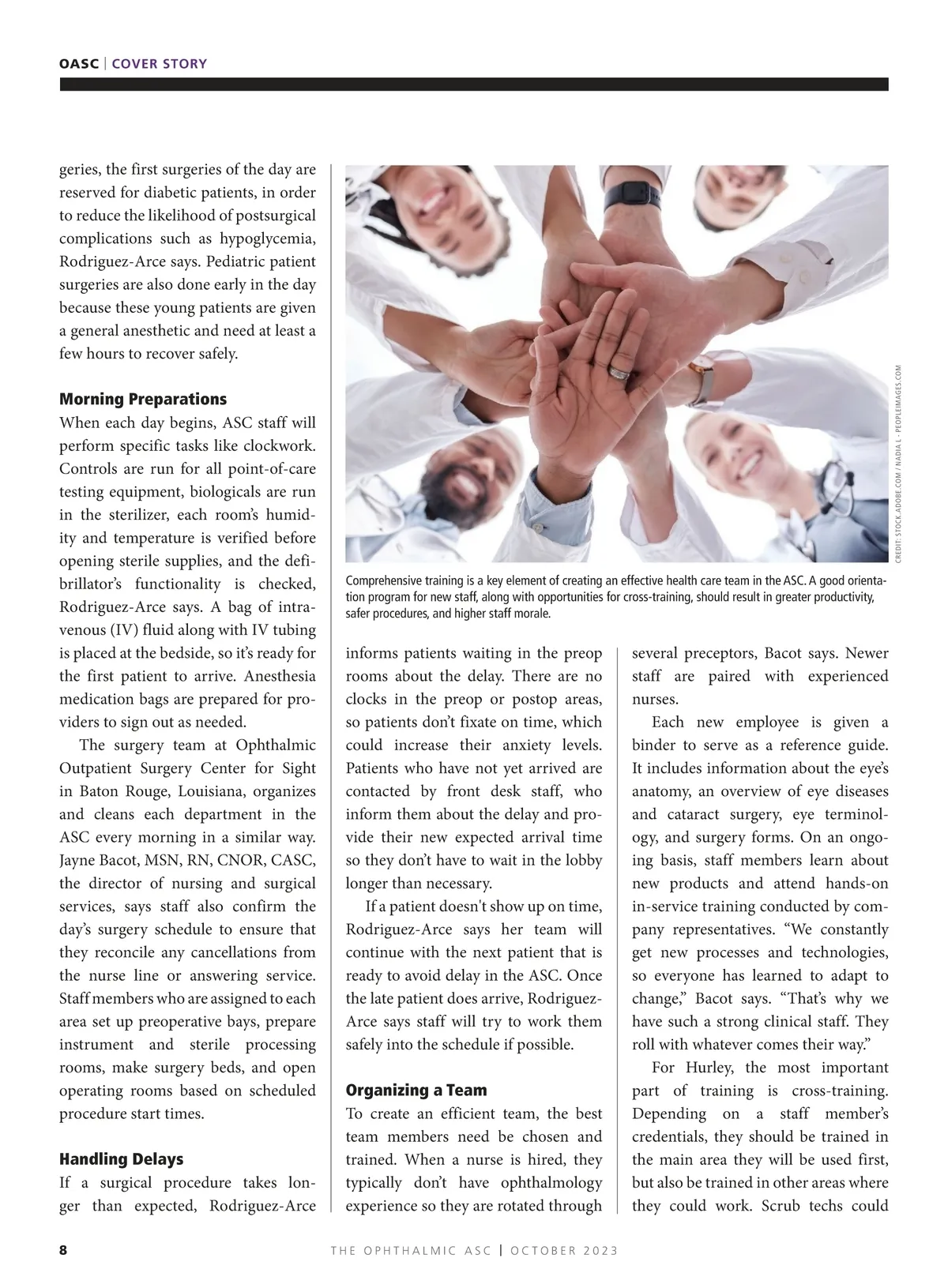
OASC | COVER STORY geries, the first surgeries of the day are reserved for diabetic patients, in order to reduce the likelihood of postsurgical complications such as hypoglycemia, Rodriguez-Arce says. Pediatric patient surgeries are also done early in the day because these young patients are given a general anesthetic and need at least a few hours to recover safely. Morning Preparations When each day begins, ASC staff will perform specific tasks like clockwork. Controls are run for all point-of-care testing equipment, biologicals are run in the sterilizer, each room’s humid-ity and temperature is verified before opening sterile supplies, and the defi-brillator’s functionality is checked, Rodriguez-Arce says. A bag of intra-venous (IV) fluid along with IV tubing is placed at the bedside, so it’s ready for the first patient to arrive. Anesthesia medication bags are prepared for pro-viders to sign out as needed. The surgery team at Ophthalmic Outpatient Surgery Center for Sight in Baton Rouge, Louisiana, organizes and cleans each department in the ASC every morning in a similar way. Jayne Bacot, MSN, RN, CNOR, CASC, the director of nursing and surgical services, says staff also confirm the day’s surgery schedule to ensure that they reconcile any cancellations from the nurse line or answering service. Staff members who are assigned to each area set up preoperative bays, prepare instrument and sterile processing rooms, make surgery beds, and open operating rooms based on scheduled procedure start times. Handling Delays If a surgical procedure takes lon-ger than expected, Rodriguez-Arce 8 CR ED I T: S TO CK . A D O B E .CO M / N A D I A L -P EO P L EI M AG E S .CO M Comprehensive training is a key element of creating an effective health care team in the ASC. A good orienta-tion program for new staff, along with opportunities for cross-training, should result in greater productivity, safer procedures, and higher staff morale. informs patients waiting in the preop rooms about the delay. There are no clocks in the preop or postop areas, so patients don’t fixate on time, which could increase their anxiety levels. Patients who have not yet arrived are contacted by front desk staff, who inform them about the delay and pro-vide their new expected arrival time so they don’t have to wait in the lobby longer than necessary. If a patient doesn't show up on time, Rodriguez-Arce says her team will continue with the next patient that is ready to avoid delay in the ASC. Once the late patient does arrive, Rodriguez-Arce says staff will try to work them safely into the schedule if possible. Organizing a Team To create an efficient team, the best team members need be chosen and trained. When a nurse is hired, they typically don’t have ophthalmology experience so they are rotated through THE OPHTHALMIC ASC | OCTOBER 2023 several preceptors, Bacot says. Newer staff are paired with experienced nurses. Each new employee is given a binder to serve as a reference guide. It includes information about the eye’s anatomy, an overview of eye diseases and cataract surgery, eye terminol-ogy, and surgery forms. On an ongo-ing basis, staff members learn about new products and attend hands-on in-service training conducted by com-pany representatives. “We constantly get new processes and technologies, so everyone has learned to adapt to change,” Bacot says. “That’s why we have such a strong clinical staff. They roll with whatever comes their way.” For Hurley, the most important part of training is cross-training. Depending on a staff member’s credentials, they should be trained in the main area they will be used first, but also be trained in other areas where they could work. Scrub techs could
Ophthalmology Management The Ophthalmic ASC October 2023: Page 8